As I drove over the hill, I saw the tree trimmer at work. One by one, he cut limbs from the tall pine. I didn’t watch the full decapitation. It was hard enough just knowing the iconic tree soon would be reduced to a stump.
It’s only a tree, Kathe, not even in your immediate neighborhood. Get over it.
But …
We knew for years that the stately old Monterey pine was fading. Later, the tree’s skeleton still stood guard over the intersection of Ardath Drive and Madison Street, reaching high into the sunset.
At the “Y” in the road, the tree had been a most visible symbol of Cambria’s extraordinary native stand of Monterey pines, the trees that blanket our hillsides nearly to the sea.
We cherish our trademark pines — especially when sunshine or moonglow glimmers through the branches, or fog weaves its ghostly fingers into the treetops.
We’re so lucky. As we go about our daily living, we get to travel through the forest. We can walk in our forest, show it off to our grandchildren and even get lost in it, emotionally or literally.
Within a few minutes, we can see sights ranging from seaside tidepools to Scott Rock. We drive along Main Street from Highway 1 into town, or along Fern or Strawberry canyons.
We hike up (and I do mean up) to the Cambria Cemetery or to Old Santa Rosa Chapel. We stroll Fiscalini Ranch Preserve and exult that it’s really ours. We spy otters or whales from Leffingwell Landing, then bicycle along the creek roads.
Sometimes we even forget to look at all that beauty. What a pity.
We also fret about the trees when weather is hot and dry, about winds, diseases, fungi, fire and more. Then when wind-driven rains deluge us, we also agonize about what the trees might do us and our homes.
Justifiably concerned, we hope to protect the forest, take care of it, properly manage it.
Some say others have overreacted in how they trimmed up brush and weeds underneath the pines. It’s all a matter of degree, I guess. One person’s mandated weed removal is another’s rape of the environment.
This is Cambria, after all. We each see our town through different binoculars.
After a while, it’s easy to think of our forest as a solitary entity. But each tree is an individual. And this tree was so prominent.
In the 1970s, crews repaved Ardath at Madison using smooth-polished beach rock. In the rain, dew or heavy fog, the rocks got wet. And slippery. Cars would suddenly and helplessly hydroplane, gliding toward oblivion.
Time and time again, the big old pine was Mother Nature’s stand-in for an emergency brake. It frequently halted sliding cars before they could tumble down the hill into what was then the home of Jerry Juhl, head writer for the “Muppet Show” and “Sesame Street.”
On each rainy night, Jerry and wife Susan would mull over their options — wait for the inevitable to happen or alert the tow-truck to stand by.
The sentinel tree at the Y in the road also served as a prominent signpost. For decades, it was in just the right spot to help people find their way. Garage sales on Marine Terrace, events at Camp Ocean Pines, parties, weddings, reunions — all were proudly announced on scrawled signs or formal banners pinned briefly to “the tree.”
Brief directions told drivers which way to go … or, in at least one case, where not to go.
That sign had someone’s name at the top, above an arrow pointing to the right. The arrow was in a circle slashed with a line drawn through it. At the bottom, the sign read, “Not that way, dummy!”
The big old pine was a neighborhood landmark. And now it’s gone.
We’re seeing more and more of these losses. Trees don’t last forever, you know. One by one, other tree guys will take down the dying, the dangerous and the skeletons.
With each removal, we’ll be left with a newly opened patch of view and a vague sense that something important is missing. And we’ll be right.
E-mail Kathe Tanner at ktanner@thetribunenews.com.
Thursday, July 26, 2007
Timber! Missing tree’s company

Wednesday, July 18, 2007
BEST OF: Line of duty drew tragically close


This column first ran four years ago, on July 20, 2003. Judges in the California Newspaper Publishers Association’s annual Better Newspapers Contest gave it the best-writing award for that year.
It was the call every journalist dreads — an assignment to cover a story about a tragedy befalling a friend or family member.
The request from The Tribune’s assistant city editor was succinct: “We’ve had a report of a structure fire six miles up San Simeon Creek Road. Can you go?”
I know what’s up there, and the knowledge hit me like a pile driver someplace between my chest bone and my belly button. It had to be on the Warren compound, a grouping of ranch houses, barns and other buildings. I’ve known the Warrens — including my “acquired brother” Bill Warren — for more than three decades.
I didn’t tell my editor about my probable ties to the call, which came Thursday afternoon (July 17, 2003), or he never would have sent me. I went, although I’m not sure why. Maybe I thought I could help the family. Maybe I was praying for a magic wand to wave.“Let it be the barn,” I whispered. “Don’t let it be Grandma Florence,” Bill’s elderly mother.
Those gut-wrenching situations happen more frequently to firefighters, ambulance crews and law-enforcement officials, especially in small towns. Soldiers, too. I don’t know how they do it. They have my profound respect.
I don’t remember much about the drive up those six hilly miles, except I was following what turned out to be the first few fire trucks going to the scene.
As soon as I rounded the corner onto the creek road, I could see the smoke. It reminded me of another day nine years earlier, when I came over a different hill and saw my own home going up in flames. Only that time, thanks to a phone alert, I knew nobody had been hurt.
This time, the worst was yet to come. As I got to the crest of the hill, I saw it. Bill Warren’s house was engulfed in flames. I parked out of the way of the oncoming hordes of fire trucks and ran up the hill.
My knees held up somehow, but my heart sank. I knew how much pride Bill had in his “treasures,” the vast collection of antiques and paintings he’d stuffed into his tiny, Cold-War-era house. He might have gone back in to get them, or to try to snuff the fire.
I reached out for Tim, Bill’s partner of more than a quarter century, and we clung together for several minutes. He told me what he knew: Bill had been on the phone talking to Tim and said, “My house is on fire.”
By the time Tim arrived, he said, the house was engulfed in flames and he couldn’t get in because the blaze was so hot. But he and Mike Johnson, Bill’s nephew who lives on the property, tried anyway.
Tim and Mike were so, so afraid that Bill was still inside the house.
With no real way to help them or anybody else, I went to work, hiding my terror behind the lens of my camera and the scribbles on my reporter’s pad. Journalists are supposed to be able to separate themselves from the pain and anguish of those they cover.
Perhaps it was easier to deal with the pain with that professional buffer zone between me and it, rather than taking it all in, head on.
But focusing on the flames was tough, knowing what might be in the rubble. My thighs, shoulders and upper arms started to shake, and I had to brace myself against a handy fire truck before I could take the photos.
I shot frame after frame, knowing all the while that readers who’ve never been at a big fire can’t begin to sense the scene from the pictures that we photographers take. There are different shades of smoke that tell experienced firefighters what’s burning. There’s the overwhelming sight of the flames and the rushing sounds of the roaring fire, crumpling walls, exploding tanks or ammunition, the muted sobs of terrified family members, the screeching of pets or livestock.
And the smell, that awful, catch-in-the-throat stench that can forever stop you from lighting a fire in a fireplace.
It takes all the senses, with full peripheral vision and more, to absorb the horror.
I kept at it. I knew Bill would want me to. All ranchers know the work never stops, no matter what. Cattle must be fed and sold, fences mended, legal matters tended to. Ranchers deal with the cycle of life and death all the time, but not this way.
The same work ethic also applies to a reporter, especially a community journalist whose primary responsibility is to a small town’s newspaper with a small staff.
Oh, Billy. Where are you?
Bill Warren was the epitome of a gentle giant, a man I looked up to in many ways. In fact, one of my favorite photos of him shows 6-foot-5-inch Bill standing beside 5-foot-1-inch me with his elbow resting on the top of my head.
He was central casting for the long, tall, lanky rancher. With his dense mustache, the inevitable logo cap and his jeans-n-boots, he fit right in at a branding, at the sales yard in Templeton or on the range.
Photos I took of Bill in 1994 show his long legs almost dragging dirt as he rode his 15-hands-high horse. He could throw a calf or a bale of hay and then turn around and tenderly scoop up a wet, tiny lamb.
When his dad, Walter Warren, was dying, Bill became the father. He carried his Walter to bed, to the bathroom. He tended his parents mornings and nights, then tended family ranchlands during the day.
Bill was the third person I met when I moved to Cambria in 1971. He took my then young sons for their first horseback ride (another photo I treasure). He took us all for what became the legendary “Uncle Billy’s Wild Jeep Ride.” He became an embedded member of our family.
In fact, just before my mother died in 1988, she said she was leaving me in good hands — those of my husband, Richard, our sons and the three “brothers” I’d acquired in Cambria. Bill was one of them.
Later, Bill’s 90-year-old mother, Florence Warren, had her family and friends, who came to grieve with her and offer her support. But that day, she could only cry out as I held her, “Why did they take my son from me? What will I do? He’s the one who takes care of me.”
A neighbor in shock said later that “Bill was the consummate caretaker. He took care of all of us.”
Five hours after I arrived at the fire, I was at my office, trying to write what I’d seen and heard, what I’d been told and what they wouldn’t or couldn’t tell me. I could tell the investigators had their suspicions, but they weren’t confirming anything about Bill until forensic tests and other elements of the investigation are complete.
I like to think that when I took that assignment, and tried to tell his story, I was returning some of the caring Bill gave to me back to his family in his name.
But it’s an assignment that will haunt me, that will make me cry again and again, that will come to me in those dark-of-night dreams that leave me shaken and disoriented the next morning.
If I could turn back the clock, would I take the assignment again? Probably. Do I know why? No. Just call it my epitaph to a good man, to a good friend and my brother.
Thursday, July 12, 2007
A lover of art, music, words turns the page
For those who don’t know Lee Sutter well, her retirement June 29 may seem just another loss to The Tribune’s fount of institutional knowledge. But for lots of us — especially our readers — Lee’s departure marks the end of a nearly two-decade era.
I remember well the day in 1992 when I called The Cambrian’s office to volunteer my services. I’d heard that the current editor was out of commission for a while, having removed several appendages when he ran over his foot with a lawn mower.
As an unpaid columnist for the paper since 1981, I knew the pressures News Editor Lee would be facing. I had a little spare time to contribute, and I wanted to help.
Without even taking a breath, Lee said, “That’s right. You can write hard news, too, can’t you?”
I’ve been a staff writer ever since.
Lee and I shared so much, dating back to The Cambrian’s final days at the old West Village location, when paste-up artists still used gooey glue to put the paper together.
Deadline day then was pure pandemonium, as we sprinted against the clock to get the flats out the door to San Luis Obispo for the all-important weekly date with the pressmen.
Our pressures and deadlines haven’t changed, but how we get to the end of our weekly race certainly has.
Lee and I worked side by side around the clock, covering storms and floods, fires, accidents and other catastrophes — the hard news of a weekly paper dedicated to its community.
We’ve held each other in long hugs as we sobbed because a beloved community member had died. We’ve raged together at injustice or governmental stupidity. And we’ve laughed. Oh, how we laughed.
We survived moving the entire office. We switched from ancient DOS-based computers to new Macs. We adjusted to new owners (several times).
In each case, we had to adapt in a flash. Given the nature of our business, we still had a paper to get out each week.
It didn’t matter that we had no idea, for instance, what Quark was, other than a basic form of matter or an obscure Eastern European cheese. Did we know how to use Quark software to format a computerized newspaper page? No. Did we do it? Yes. Quickly.
Lee taught me so much, as a writer, proofreader and human being.
As any former Sutter student will tell you, it’s a vast understatement to say Lee is compulsive about grammar, spelling and punctuation (especially hyphens). She’d make lists of common errors, then grill us on them. We’d often arrive for work to find corrections scrawled on Post-Its stuck to our computer monitors.
Yes, sometimes, when we’d made the same mistake for the fifth time, she’d get … well, cranky. But know what? We never forgot those particular edicts again.
My favorite Lee memories, however, are of her dedication to her work, her glee when writing about a band she loved, or seeing work by an artist she admired, or reviewing a book she’d absorbed in a single sitting.
The A&E (arts and events) pages are where her heart was and is. And her enthusiasm would glow through the newsprint into readers’ souls. (Fortunately, she’ll still be doing some arts features for The Tribune and Cambrian. Lucky us.)
Lee is a devoted friend and defender for her cadre of artistic creators, her nonprofit folks, readers in general and always for underdogs and the underprivileged.
She also has a maniacal laugh. Put Lee and cartoonist/musician/artist/inventor Art Van Rhyn in the same room and, in minutes, everybody’s guffawing.
Often, Lee would giggle and, not even knowing what had tickled her funny bone, I’d laugh and we’d be off to the races for 10 or 15 minutes.
Anybody walking through the door surely should have called for the men in white coats. But most visitors simply joined in the hilarity. Fortunately, lots of Cambrians are just as quirky as we are.
So many good memories.
I’m delighted for Lee, that she’ll have her summer and her life ahead of her while she’s young and spry enough to enjoy them. She’ll have decades filled with Live Oak fests, camping trips, jaunts with daughter Stacy, songwriting and singing, playing with the Center Street Mercantile & Blacksmith String Band and other groups, spur-of-the-minute adventures and so much more.
Go get ’em, girl. You’ve earned it. But wow, Lee, we’ll miss you.
Note: Send art show announcements to Lee Sutter at sutterlee@hotmail.com.
Tuesday, July 3, 2007
BEST OF: A (bushy) tale of lost opportunities
I didn't know squirrels could swear. What a surprise.
The fuzzy-tailed little foragers are the bane of boardwalk managers, gardeners, farmers, ranchers ... and those who feed wild birds at home.
At Tanner Manor, husband Richard fills a variety of tubes, towers and platters with birdseed and various globes with sugar syrup. He also carries a pocket full of peanuts.
We tell him, but not too vehemently, that a truly dedicated wildlife lover shouldn't feed the critters.
But, ‘fessing up, we all enjoy watching hummingbirds zooming past to defend their feeders against anything larger than a mosquito and smaller than a breadbox. We watch flocks of little birds pushing and shoving at the feed trough, and laugh at scrub-jay antics when they're reminded it's physically impossible to simultaneously pick up three peanuts-in-the-shell in one beak.
A free lunch for squirrels
However, it never was Richard's intention to provide a Hometown Buffet for squirrels.
Oops. We forgot to tell the squirrels.
Originally, Richard thought that hanging a feeder from the roof on a long, slick wire would do it.
Bosh.
Following that installation, our first fluffy explorer dashed across the roof, skittered down the beam from which the feeder hung and looked puzzled.
After some abortive tries over several days, he made his move. He slowly inched over the edge of the overhang, and, clutching the board for dear life with one paw, he reached out with the other to grab the wire, which became his fireman's pole.
It was all over but the egress.
After filling up with seeds, the squirrel pondered his options. He tried several times to crawl up the wire, but kept backsliding down, clonking himself on the top of the feeder roof as he landed. Finally, the explorer set his shoulders, clenched his jaw to secure the seeds and leapt off the feeder to the deck, about 8 feet below.
We had ourselves a flying squirrel. Swell.
We tried various other feeders and schemes, none of which deterred the cagey critters for long. In the meantime, the squirrels' tunnels and burrows began undermining the bluff by our home. Landscapers clucked and fretted about the land's stability if the beasties continued to feast on seeds and dig in the dirt.
"If you find a feeder they can't get into, we won't have to poison them," they admonished. Gulp. Poison?
A better bird feeder
Then Editor Bert got a spiffy three-tube bird feeder, which he installed outside his window at The Cambrian's office. It looked almost squirrel proof, by golly, with its tightly capped, long, narrow tubes, each about 2-1/4 inches in diameter. We went right out and bought one of our own, and it seemed to work.
However, when we got back home after a vacation, Richard noticed that one of the tubes' top caps had disappeared. How strange. It had been a snug fit, tough enough for him to remove at fill-up time. We didn't think bird could dislodge the cap, unless turkey vultures have taken to attacking errant bird feeders.
Then Richard saw the culprit.
My chuckling husband reported his findings. "The squirrel had removed another cap and had wedged his body about two-thirds of the way down into one of those skinny tubes. It was a tight fit. His body completely stuffed the tube and only the tip of his tail stuck out the top.
"He was almost inhaling the seeds — I could actually watch the seed level going down."
Then the squirrel spotted Richard.
"He tried to wriggle back out, but what had slid easily into the tube was having a heck of time getting back out again," my husband reported. "His cheeks were too full, and he couldn't get enough traction to force himself out backwards. We had an empty feeder tube and a very full squirrel."
That’s when the air turned blue with squirrelly blasphemy. In the imaginary cartoon balloon over his head, the expletives were not deleted.
The critter wriggled, squirmed and twisted, to no avail. His was the classical image of a frantic, defiant little boy caught with his hand in the cookie jar.
Spewing seeds and swear words
Finally, the thoroughly disgusted squirrel spat some seeds back into the tube, a few at a time, just barely enough so he finally could tug himself free. He popped out of the tube like an animated champagne cork, and ZIP — he was gone, spewing more seeds, pure rage and profanity as he vanished.
By then, Richard was gasping for breath and bent over double, guffawing about what he'd seen. Watching a thoroughly ticked-off squirrel clearly was much better than seeing the best Marx Brothers' movie.
Yes, we're still in the market for a squirrel-foxing bird feeder. But in the meantime, we'll have lots of fun trying to translate squirrel cuss words.
This column ran in The Cambrian on Sept. 30, 2004. Since then, we have abandoned the idea of dispensing free bird seeds. The squirrels won this round. But we inadvertently visit them every time we take a walk on the Moonstone Beach Drive boardwalk. And, along the way, if we don't feed the fuzzy little rodents, we still get our ration of squirrel blasphemy.
Thursday, June 28, 2007
Oops! Did I say that out loud?
Do you talk to yourself … not out loud, but inside your head? I’ve done it all my life. Sometimes it worries me. But mostly, I figure everybody does it.
It’s different than regular thinking. I’m holding mini-conversations with myself, as I hash out problems, practice what I want to say to someone, chastise myself or even lavish a little self-praise.
Often, I talk to myself as I’m driving. As my body takes one trip, my mind is on another, with random thoughts bobbing about like Styrofoam pellets in a stiff wind.
But my self-chats keep me company, keep me awake and don’t distract me nearly as much as talking on a cell phone would.
Sometimes, I talk to myself about what I’m seeing from my mobile, metal cocoon.
For instance:
“My goodness, that’s a tire sticking up halfway out of the bog. Wonder how it got there? Hmmm. I could make believe I’m the artist Christo and stick hundreds of mannequin arms and legs into the mud out there. Would anybody notice and, if they did, what would they think?”
Or: (Screeech.) “You idiot! Whaddya mean, doing 80 in a 55 mph zone!”
Or: (A sister discussion.) “Geez, I believe in being safe. But putting along at 8 mph when the speed-limit sign said 35?”
Or: “ ‘PARADDL.’ Now that’s a cool personalized license plate! I actually know what it means (I’m the daughter of a musician — paradiddle is a drum roll). But that other personalized plate over there doesn’t make any sense at all. I want to stomp over and ask the driver what in *&^%$#@ it means.’” I haven’t done that yet, but someday …
Some of my best self-talks are about mental snapshots I take as I drive along.
For instance, I spied an older man walking slowly along Cambria’s Main Street, heading for Highway 1. He didn’t look happy about what he was doing.
All of a sudden, there was a curb alongside his feet.
The man surreptitiously looked around to see if anybody was watching, but didn’t spot me. He grinned, then hopped up on the curb. Using his arms for balance as a tightrope-walker would, he almost skipped along the raised concrete edging.
I told myself it was like watching Archie Bunker morph instantly into Peter Pan.
Another time, as we drove north on Highway 1 near Año Nuevo, we saw a Norman Rockwell-style image of agriculture in progress.
A man was walking slowly along some freshly harrowed rows. At regular intervals, he’d reach into the big knapsack at his side and grab a handful of what appeared to be large seeds — perhaps for the area’s legendary pumpkins.
In a graceful movement choreographed by years of experience, he sowed the seeds, which flew from his fingers in an even, fan-shaped spray.
“It’s just like a modern dance,” I said in my head, and then repeated it for husband Richard.
He had noticed the man, too.
“Reminds me of Daddy Anderson,” he said of his former father-in-law.
Daddy Anderson spent his entire life tending the soil of his Northern Utah farm. Often, as he’d check his fields, he’d absentmindedly reach down for a pinch of dirt. He’d roll it around between his thumb and a couple of fingers, then put a bit of it on his tongue.
He was so in tune with his land, he could taste if something was wrong with the soil.
That’s a real farmer. He was worlds away from cowboy-hatted, lizard-skin-booted agribusiness CEOs who talk the talk, but couldn’t walk their way out of a corral without falling face-first into the manure.
And wouldn’t that be a mental image to talk to yourself about?
It’s like the old story about the little boy who asked the man, “Hey mister, are you a real cowboy?”
“Why yes, I am,” the rancher drawled. “See my cowboy hat, and my cowboy shirt? I’ve got a real Western belt and gen-u-ine Levi’s jeans.”
“But mister,” the boy said, “you’re not wearing cowboy boots!”
The man paused and said, “Now, son, I wouldn’t want to be mistaken for a California truck driver.”
Wednesday, June 20, 2007
BEST OF: We hold this truth to be self-evident
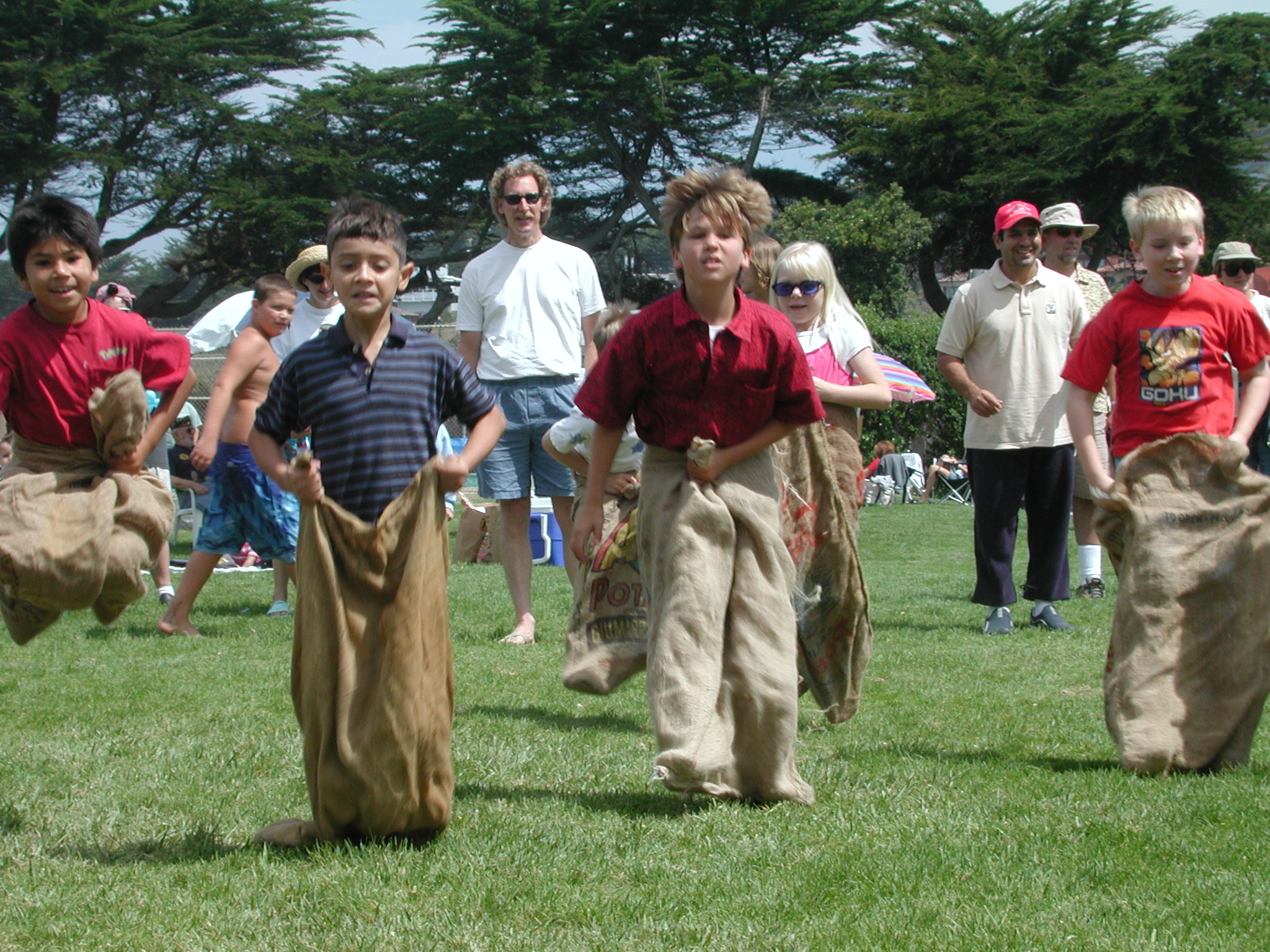
Cambria’s Independence Day festivities are billed as an "Old Fashioned Fourth of July Celebration."
Is there any other kind? Have you ever been tempted to attend a "New Wave Fourth of July"?
Me neither. In fact, I've never even seen one suggested.
Maybe that's because some things are best when left alone.
It's called tradition.
It brings to mind a recent recipe I read for dressing up watermelon. Cubes of the fruit were frozen, then sprinkled with sun-dried tomatoes and drizzled with basil-and-chipotle-infused syrup.
It might be wonderful, but it's not watermelon the way I want to remember it. And I think I'll pass this time.
Year after year after year, the American Legion's Independence Day celebration at Shamel Park does tradition, which is exactly what it's supposed to do.
It gives me a lump in my throat when I see the color guard and the flag, when I hear the anthem.
We giggle as we watch kids of all ages try to run forward with one leg in a shared sack or catch a water balloon without breaking it.
Everybody gathers around and cheers their favorite servers, as we wonder whether San Simeon Bar & Grill will win the waiter-waitress race again this year.
We eat all the wrong things and enjoy every bite. We listen to the music and might even get up to dance (if we can hide in a remote corner of the park).
And we thrill to the fireworks display, which we find much more fun to watch than overwhelming gazillion-dollar shows that fill the sky for hours with so many bursts and blasts, you really don't get to enjoy any of them individually. Those mega-shows are so overwhelming, my eyes and ears get tired.
Tradition.
Cambria’s Shamel Park celebration reminds me of my childhood, of Independence Days spent with family at Manursing Island Country Club in Rye, N.Y.
I remember swimming off and on all day with my Aunt Kate (only a couple of years older than I am) and Cousin John. We frolicked until we were human prunes. When we got dressed, we had that strange dizzy sense that comes with being in dry clothes after having been in the water so long.
We'd go to the little poolside snack bar and get big vanilla ice-cream cones. The clerk would give us each a cone-shaped paper cup of chocolate shot to dip the rapidly melting ice cream into.
Yum.
The next big event was the buffet dinner in the dining room that overlooked Long Island Sound.
We'd devour the shrimp in cocktail sauce, the fried chicken, the deviled eggs and those bite-sized chocolate eclairs.
And, as dusk fell, we'd marvel at the fireworks.
Tradition.
Several decades ago in Cambria, the Independence Day celebration was on hiatus for a while.
The now defunct North Coast Property Owners Association revived the fireworks, much to the glee of residents and visitors, who'd been rather sulky over the lack of festivities.
When the association folded, the Cambria Chamber of Commerce took over and expanded the event.
Recently, I reminisced about all that with Del Clegg of Cookie Crock Market fame. He and I were among the directors on the chamber's board then.
He teased me about my having to wear a tall, sequined red hat with a long, blue feather on it.
I'm so short, that was the only way the other organizers could find me in the crowd.
The chamber was determined to make the event family friendly. We’re so glad it has stayed that way, thanks to American Legion Post No. 432.
We know how hard it is to pull together an event like that, how many people it takes doing so many tasks.
Del also reminded me of the 8-foot-long strawberry shortcake that husband Richard and I provided to the ceremony each year from our bakery. The shortcake required pounds of homemade, buttered sourdough biscuits, gallons of whipped cream and enough crushed fresh strawberries to fill several good-sized trash cans.
We'd assemble it all on a specially painted door, slide it into the back of the van and drive veerrrrrrrryyyyyy slowly to Shamel Park.
And the work goes on.
For instance, that holiday hot dog you munch requires people to make the plans and the commitment, buy the hotdogs, buns, relish, mustard, napkins and other accessories and find folks to run the booth.
They set up and fire up the barbecue, decorate the booth, cook the dogs, sell them, keep things stocked, clean up the mess afterward, tear down the equipment, take it home, clean it and put it away (that was always the part I hated most!).
And just what do you do with five open jars of pickle relish on July 5?
On Independence Day, for every booth and every activity, it takes people willing to give up weeks of their time to provide the rest of us with one day of fun.
That's an old-fashioned Fourth of July. That's tradition. That's how it should be.
Thank you, American Legion and all your cohorts. Long may you reign.
Answer to Anonymous' comment: A waiter-waitress race is scheduled for 1 p.m. at the park.
Kathe Tanner is an award-winning reporter for The Tribune and The Cambrian. She also has written a column for The Cambrian since 1981. This one was published on June 29, 2006.
Thursday, June 14, 2007
Yes, kids today do care about learning
 Anna’s a waif of a 10-year-old, with an innate sparkle that could ignite fireworks and a shy grin that makes you want to echo-smile from ear to ear in response.
Recently, after I met the Michel family, Anna snuggled up to her dad and listened intently as I asked him questions during a casual interview.
Paul Michel is the new superintendent of the Monterey Bay National Marine Sanctuary. The family was visiting the sanctuary’s southern gateway at San Simeon’s
Normally, I’d be reporting about what Paul said and his views on such topics as desalination plants, Davidson Seamount, the wreck of the
Later. This is about Anna.
She continued to watch me and listen, obviously making mental notes about something.
Finally, her mom, Bev, explained that the home-schooled child has an assignment to interview her grandmothers, ages 80 and 70.
Wow! What a great way to learn about history!
The Michels have an unusual household. For instance, they don’t have TV, preferring to have Anna and her mischievous younger brother Alex get news from newspapers — which can be put away when the stories get too intense or repetitive for young folks.
Paul and Bev also minimize at-home computer use, wanting their children to refine writing skills and penmanship at the same time.
I explained to Anna why I ask certain interview questions and what I hope to learn from the answers.
Then she started asking me some insightful questions of her own.
What a delightful change from the "shutters slamming shut behind the eyes" reaction one often gets from children, teens … and even some adults.
I told Anna about a questionnaire I prepared long ago to help pry memories from reluctant senior citizens.
Some people slough off questions about their lives. "I’m nobody important," they protest. "I don’t have anything interesting to say. And if I do, I don’t remember it."
My questionnaire seeks to overcome that informational dam with topics as diverse as "What did your mother pack in your school lunches?" and "What were your early homes built from, and who built them?" and "Did you have a pet, and if so, what?"
I also suggested other ideas, such as having a tea party for Grandma and other relatives or longtime friends.
Show them photos from long ago, and it can be amazing what recollections those pictures will trigger. The seniors often will spar with each other about who really is who in a photo and what they really were doing.
A video or audio recorder can capture those good- natured arguments and the priceless tales within.
I also asked Anna to send me her reports when they’re done.
Anna, Alex and other bright kids provide the decidedly upbeat answer to a vital question — do future generations really care about learning, or about the history of a house, a village, a nation … or a family?
You betcha.
That night, I thought what fun it could be to have Anna, Alex and our youngest grandkids all together at an event like
We’d bring some hoops to roll (or hula) around the Guthrie-Bianchini house, and play some Victorian-era games, to match the house. We’d share a picnic in the shade of the big trees and have a good, old-fashioned time.
No Xbox? Who cares? We’d have fun just being together. And we’d all be learning, too.
At the Castle ceremonies the next day, Anna greeted me with another incandescent smile, a big hug and a tightly folded piece of notebook paper.
As buddies often do, even across generational divides, we talked and giggled off and on for a couple of hours.
Later, I opened her paper.
It was a multicolored sketch of a waterway, pretty flowers and bees, with a note in her neat cursive writing:
"Dear Kathe, Thanks for being so friendly and welcoming. You inspired me. Your friend, Anna Michel."